

Sourcing Agent for Toys in China: Complete Guide
Toys are the import category where a sourcing agent either earns the fee or wastes it. For kitchenware or phone cases, a bad batch is an annoyance: the buyer complains, you replace the goods, and life goes on. For toys, a bad batch is a recall. A plush toy that sheds fibres, a plastic figure with lead paint, or a button battery a child can reach can pull your whole shipment off the shelf and put your brand on a regulator's list.
That is why a toy sourcing agent is a different job from a general merchandise agent. The agent you want knows which factory makes which kind of toy, which lab test your destination market requires, and how to read a test report instead of just collecting it.
Key Takeaways
- Safety is the product. Toys are regulated as children's products in every major market. The standard depends on the destination, not the toy: EN71 for the EU, ASTM F963 plus CPSIA for the US, UKCA for Great Britain, AS/NZS ISO 8124 for Australia and New Zealand.
- The agent's real job is verification, not finding the cheapest quote. Matching you with the right factory, checking age grading and labelling, booking the right lab tests, and running toy-specific quality control are worth more than a lower unit price.
- Chenghai in Shantou is the centre of the industry. Market reports put over 12,000 toy-related businesses in the Chenghai district alone — mould makers, raw-material suppliers, assembly lines and packaging printers all within a short drive.
- Market-reported agent fees run roughly 5–10% commission on order value, with some agents charging a flat 5% on the factory-direct price. Get the fee in writing, with the factory price shown separately.
- MOQs are negotiable but real. Market-reported ranges put stock items at roughly 5–10 master cartons per SKU (about 120–480 pieces), and custom OEM runs at roughly 1,000–3,000 units. Always verify with a written quotation before ordering.
- Never approve production on a photo alone. The sample is the specification: test it, age-grade it, and confirm the test report covers your exact model number.
Why Toys Are Different: Safety Is the Product
Every import category has quality risks. Toys have legal ones. In the EU, the UK and the US, the business that places a toy on the market is legally responsible for its safety — not the factory, and not the agent.
Three things make toys harder than most categories:
- The user is a child. Children under three put everything in their mouths, and older children chew parts, pull seams and drop toys repeatedly.
- The rules change by market. There is no single worldwide toy certificate. A toy that passes EN71 for Europe still needs ASTM F963 and CPSIA paperwork for the United States, and test reports are product-specific.
- The failures are invisible. Lead in paint, phthalates in soft plastic, a magnet that detaches, a battery compartment a child can open — none of these show up in a photograph or a standard visual inspection. They only show up in a lab test and a functional check.
A good toy sourcing agent manages exactly those three risks.
Where China's Toys Come From: Chenghai and Beyond
China manufactures roughly 80% of the world's toys, according to market reports — but the toys do not all come from the same place. Different clusters specialise in different products, and matching your product to the right cluster is the first decision an agent makes.
| Cluster | Main products | Best for |
|---|---|---|
| Chenghai, Shantou (Guangdong) | Plastic toys, RC cars, electronic and battery-operated toys, action figures, educational and STEM toys, diecast models | Manufactured plastic and electronic toys; the deepest factory base in the world |
| Yiwu (Zhejiang) | Small mixed toys, plush, party and novelty toys, low-cost assortments | Small mixed-carton orders and spot goods across many categories |
| Shenzhen / Dongguan (Guangdong) | Electronic toys, smart toys, app-connected toys, high-end RC | Electronic toys needing circuit boards, firmware or app integration |
| Yangzhou (Jiangsu) | Plush toys and soft toys | Plush, stuffed animals and fabric toys at scale |
| Ningbo (Zhejiang) | Wooden toys, educational toys, outdoor toys | Wooden and educational ranges |
Chenghai deserves a closer look, because it is where most serious toy orders start. Market reports describe over 12,000 toy-related businesses in the district, and permanent toy showrooms display samples from thousands of local manufacturers, so an agent can compare dozens of factories in a day. Market reports put Chenghai's share at over 50% of China's plastic toy output and roughly a third of global supply.
Yiwu plays a different role. It is a multi-category wholesale hub, and the right choice for small mixed assortments across many toy types — but it is mostly trading companies and spot goods. If you need a custom mould, a specific Pantone colour, or a factory that owns its production line, Chenghai is where the agent will take you.
Toy Safety Standards by Market
Confirm the destination market before any factory is contacted, because the testing plan, the labelling and the paperwork all follow from it.
| Market | Core framework | What you need on file |
|---|---|---|
| European Union | Toy Safety Directive 2009/48/EC + EN71, REACH, GPSR | CE mark, EU Declaration of Conformity, EN71 test reports, REACH reports, an EU responsible person |
| United States | CPSIA + ASTM F963 | Children's Product Certificate (CPC), third-party test reports from a CPSC-accepted lab, tracking labels |
| United Kingdom | UK Toy (Safety) Regulations 2011 | UKCA mark, UK declaration, importer name and address, BS EN 71 test reports |
| Canada | CCPSA Toys Regulations | Test reports to the Canadian requirements, labelling in English and French |
| Australia / New Zealand | AS/NZS ISO 8124 | Test reports to the AS/NZS ISO 8124 series |
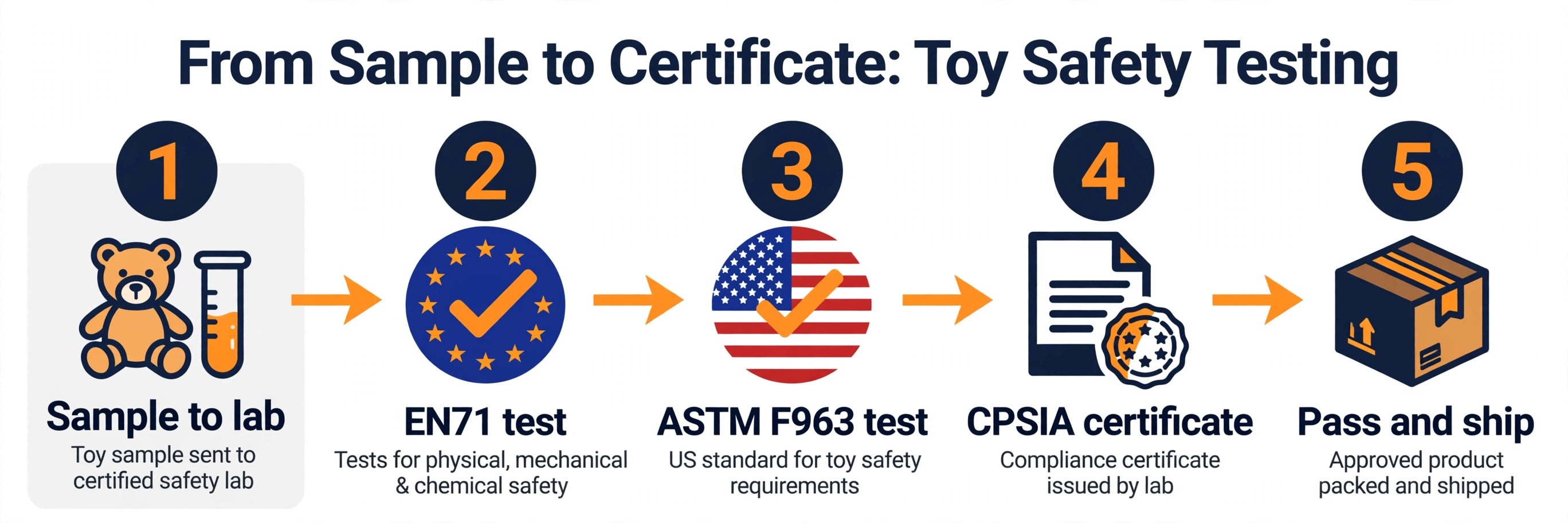
The three frameworks most buyers meet are EN71, ASTM F963 and CPSIA. Here is what each one actually covers:
- EN71 (EU and UK). The harmonised European standard family behind the EU Toy Safety Directive. It is a series of parts: EN71-1 covers mechanical and physical properties (drop, torque, tension, sharp points and edges, small parts for under-3s, cords, projections, magnets); EN71-2 covers flammability; EN71-3 covers migration of certain elements, including heavy metals from coatings and paints.
- ASTM F963 (US). The American consumer safety specification for toy safety, mandatory in the US for children's toys under CPSIA. It covers mechanical and physical hazards, flammability, heavy-element content, small parts, sharp points and edges, and age grading — plus category-specific requirements such as battery-operated and projectile toys. Test reports should cite the current edition; older revisions are a common reason for rejected entries.
- CPSIA (US). The federal law that sits above ASTM F963. It adds lead limits (100 ppm in accessible substrate, 90 ppm in surface coatings), phthalate limits (eight phthalates restricted to 0.1% in accessible plasticised components), mandatory third-party testing by a CPSC-accepted laboratory, a Children's Product Certificate per product, and tracking labels.
Two checks your agent should run on every test report: the report must name your exact model number, material and coating combination — a generic certificate is not proof — and the test date must be after your product's last design change. For US orders, the CPC must be based on testing at a CPSC-accepted third-party lab, and your customs broker should have the certificate data ready before the cargo arrives.
What a Toy Sourcing Agent Actually Does for You
A toy agent's work differs from a general agent's work in six specific ways.
1. Turn your idea into a toy brief the factory can quote
The agent turns your product idea into a sourcing brief: product type, materials, dimensions, target price, quantity, packaging, age grade, and your destination market's certification requirements. A toy graded 3+ and a toy graded 0–3 are tested differently, labelled differently, and made with different materials — so the brief must state the age grade upfront.
2. Match the toy type to the right factory
Toy factories specialise narrowly. A plush factory does not make RC cars; an RC factory does not sew plush. The agent's first value is knowing which factories make your toy type, and separating manufacturers from traders — a trader sells the same product at a higher price with less control.
3. Sample testing — the sample is the specification
The agent orders samples and tests them the way a child would use the toy: pull the seams, tug the eyes and buttons, drop it, twist the joints, open the battery compartment, and check every small part. Three units from the same batch, not one. Market-reported sample production runs roughly 15–35 days. Agree in writing what happens if the sample fails: who pays for the re-sample, and how many rounds are included.
4. Testing and certification — booked early, not at the end
The agent books the lab tests early, because a failed test late in the schedule costs you the shipping window. The agent confirms which EN71 parts or ASTM F963 clauses apply, sends the sample to an accredited lab, and reads the report — checking the model number, the test date, and the clauses actually tested.
5. Toy-specific quality control during production
Toy QC is not a generic visual check. The agent's inspection covers seam strength and stitching on plush, paint adhesion and colour matching on plastic, function and battery safety on electronic toys, and small-parts and sharp-edge checks on everything. Market-reported practice is inspection to AQL 2.5 for major defects.
6. Packaging, labelling and shipping — the last mile of compliance
The agent checks the packaging and labelling before the goods leave: age warnings, CE or UKCA marks, tracking labels for the US, choking-hazard warnings where required, and the correct language for the destination market. Then the agent consolidates the order — collecting goods from several suppliers at one warehouse and shipping as one consignment — and confirms the battery paperwork where relevant: lithium batteries in electronic toys need UN38.3 test documentation before a carrier will accept them.
Plush vs Plastic vs Electronic Toys: What Changes
The toy type changes the factory, the tests, the MOQ and the failure modes.
| Toy type | Main factories | Key tests and risks | Typical MOQ shape |
|---|---|---|---|
| Plush and soft toys | Yangzhou, Yiwu, Chenghai | Seam strength, fibre shedding, small parts (eyes, buttons), flammability, stuffing material | Lower MOQs for stock designs |
| Plastic toys and figures | Chenghai | EN71-1 mechanical tests, EN71-3 heavy-metal migration, paint adhesion, small parts, mould quality | Stock items from roughly 5–10 master cartons per SKU |
| Electronic and RC toys | Chenghai, Shenzhen, Dongguan | EN62115 / ASTM F963 battery sections, battery accessibility, overheating, firmware and function, UN38.3 for lithium batteries | Higher MOQs; custom electronics need a longer sample cycle |
| Wooden and educational toys | Ningbo, Chenghai | EN71-1 sharp edges and small parts, EN71-2 flammability, EN71-3 migration from coatings and paints | Moderate MOQs; paint and coating compliance is the main risk |
Plush is the most forgiving category for a first order: the materials are simple, the tests are well understood, and the failure modes are visible. Electronic toys are the hardest: the failures are invisible and the certification stack is the longest. If your first toy order is electronic, the agent is not optional.
How Much Does a Toy Sourcing Agent Cost?
Agent fees for toys are usually quoted in one of three models. All figures below are market-reported ranges from SERP sources — planning numbers, not quotations; verify every line with a written quotation before ordering.
| Fee model | Typical market-reported range | Best for | Main risk |
|---|---|---|---|
| Commission on order value | Roughly 5–10% of goods value; some agents charge a flat 5% on the factory-direct price | Repeat orders | Hidden kickbacks or inflated pricing if the factory price is not shown separately |
| Per-service fees | Factory audit commonly quoted around $300–$800; inspection from around $419 per man-day | One-off checks | Costs add up; agree the full list upfront |
| Flat project fee | Quoted per project, often for a sourcing sprint of 2–4 weeks | A defined first order with a clear scope | Scope creep — agree in writing what is included |
Three questions that expose a bad fee structure: Is the factory price shown separately from the fee? Is the fee in writing, with what is included and what is extra? And does the fee shrink as your order grows?
What the fee buys on a toy order: the brief, the factory match, the sample testing, the lab-test booking and report reading, the production follow-up, the toy-specific inspection, and the packaging, labelling and shipping coordination — as one accountable job.
MOQ, Samples and Lead Times
Toy MOQs depend on whether the product already exists or needs a new mould. Market-reported ranges from SERP sources:
- Stock or catalogue items: roughly 5–10 master cartons per SKU, typically 120–480 pieces. Some agents negotiate smaller pilot orders of 50–200 pieces for first-time buyers — but a pilot order is a favour the agent negotiates, not a standard factory term.
- Custom OEM with new moulds or custom colours: roughly 1,000–3,000 units per SKU depending on size and complexity. A new steel mould is a one-off tooling cost on top of the unit price, commonly quoted in the low thousands of dollars.
- Samples: roughly 15–35 days for production, depending on customisation and factory load. Sample fees are usually charged at cost and sometimes credited against the first bulk order — agree this in writing first.
- Payment terms: the standard structure market sources report is 30% deposit with the balance tied to inspection and shipment milestones, typically 70% against the bill of lading copy after a passed pre-shipment inspection.
Lead time is where toy orders most often slip: the lab test, the sample approval, and the mould (for custom items) all sit before production starts, so build testing time into your calendar before you promise a delivery date.
IP and Licensing: Branded Characters
Branded characters are the fastest way to lose money on a toy order. A factory that offers you a well-known cartoon character at a low price is almost certainly offering an unlicensed copy — and the liability sits with you, the importer, not the factory.
Three rules your agent should enforce:
- Licence first, production second. If you want a licensed character, the licence agreement comes before the mould is cut. The agent should ask for the licence document and confirm it covers your product type, your territory, and your sales channel.
- No licence, no character. If there is no licence, the toy must be an original design. A "similar" character with a changed name is still an infringement risk.
- Own your design. For original designs, agree in writing who owns the mould, the artwork and the packaging design.
How to Vet a Toy Sourcing Agent
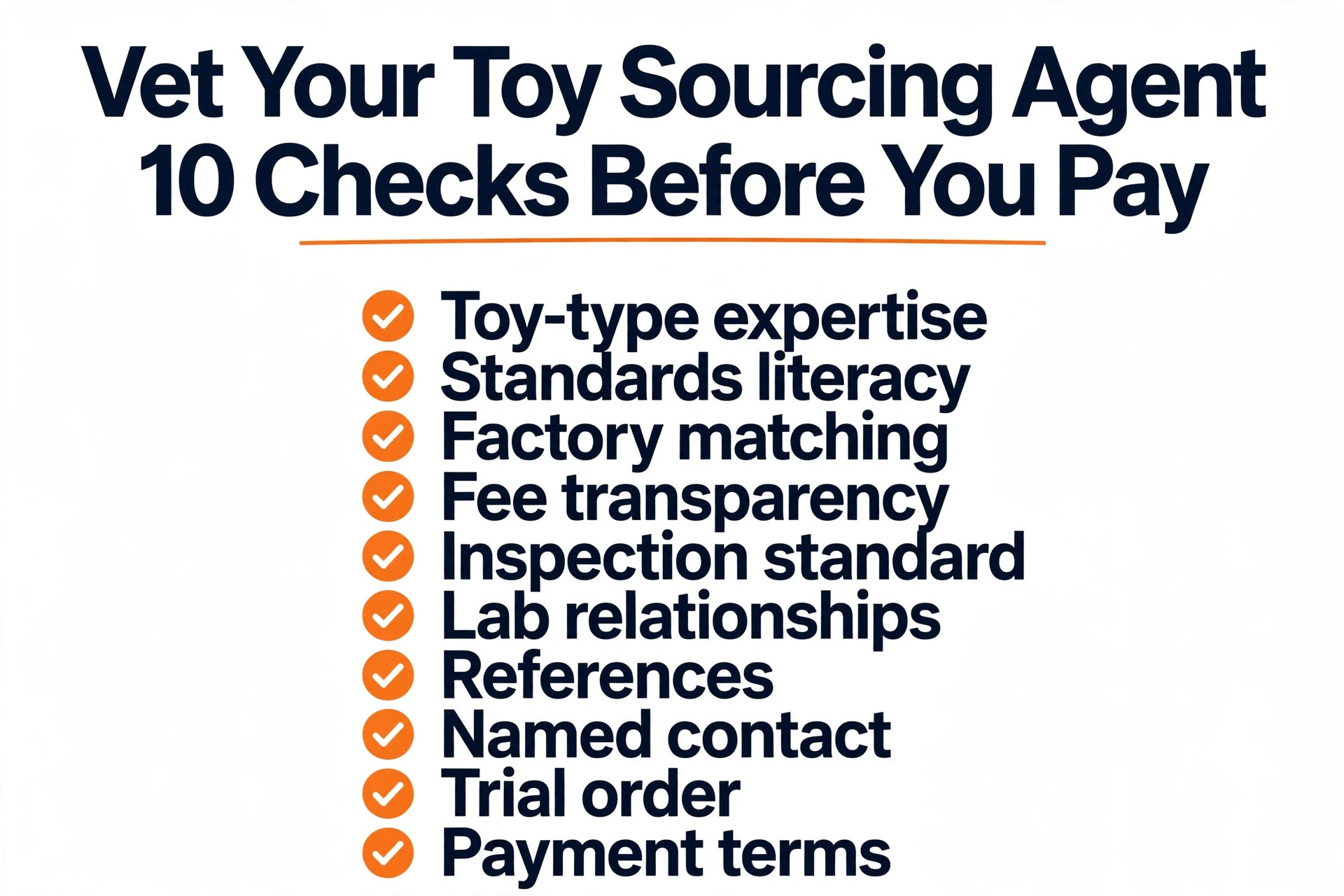
Use the same checklist on every agent. Score each one before you pay a deposit, and keep the answers in writing.
- Toy-type expertise. Has the agent handled your toy type before — plush, plastic, electronic, wooden? Ask for the last three orders in your category.
- Standards literacy. Can the agent explain which EN71 parts or ASTM F963 clauses apply to your toy, and what a CPC is? Ask them to walk through a test report.
- Factory matching. Can the agent name the cluster your toy belongs in and why?
- Fee transparency. Is the factory price shown separately from the fee, in writing?
- Inspection standard. Does the agent run toy-specific checks — seam strength, small parts, battery safety — or only a generic visual inspection?
- Lab relationships. Does the agent work with an accredited lab, and can they show you a real test report they have read?
- References. Can the agent name two reference buyers in your product category and order size — and can you call them?
- Named contact. Who owns your order from brief to delivery — one person, not a shared inbox?
- Trial order. Will the agent take one small trial order with the same process and pricing logic as a full order?
- Payment terms. Is payment staged — deposit, then balance after inspection — with the final payment held until the goods pass?
How to use it: any agent that fails checks 1, 2, 4 or 5 is not a candidate for toys, however cheap the fee. An agent that passes all ten is worth a trial order — judge the agent on the sample test report, the inspection report, and the final invoice against the quote, not on the sales call.
Red Flags: When to Walk Away
- Cannot explain EN71, ASTM F963 or CPSIA. If the agent forwards your spec without checking which standard applies, they add a margin.
- No factory visit, or a "virtual audit" only. An agent that has never set foot in the factory cannot tell manufacturer from trader.
- Fee hidden inside the factory price. If the agent will not show you the factory's price separately, the fee is whatever the agent decides it is.
- 100% payment upfront. The standard structure is a deposit with the balance tied to inspection and shipment milestones.
- No test reports, or a report for a different model. An agent that accepts a test report at face value will ship you a toy that fails customs.
- Branded characters with no licence. An agent that offers a famous character without asking about the licence is not ready for toys.
- No trial order, no references. An agent that will not take a small trial order, or cannot name two reference buyers in your market and volume range, is telling you something.
- Pressure to decide today. Sourcing takes days, not hours.
FAQ
What does a sourcing agent for toys in China actually do?
The agent turns your product idea into a toy brief with the age grade and destination market stated upfront, matches your toy type to the right factory, orders and tests samples the way a child would use them, books the right lab tests and reads the reports.
How much does a toy sourcing agent cost?
Market-reported ranges are roughly 5–10% commission on order value, with some agents charging a flat 5% on the factory-direct price, or per-service fees such as an audit around $300–$800 and inspection from around $419 per man-day.
What safety standards do toys from China need?
EN71 for the EU, ASTM F963 plus CPSIA for the US, UKCA for Great Britain, and AS/NZS ISO 8124 for Australia and New Zealand. The test report must cover your exact model number, material and coating combination.
What is the minimum order quantity for toys from China?
Market-reported ranges put stock or catalogue items at roughly 5–10 master cartons per SKU (about 120–480 pieces), and custom OEM runs with new moulds at roughly 1,000–3,000 units depending on size and complexity. Some agents negotiate smaller pilot orders of 50–200 pieces for first-time buyers. Always verify the MOQ with a written quotation before ordering.
How do I check if a toy factory in China is legitimate?
Ask the agent for an on-site audit report: business licence and export licence, proof the factory makes your toy type, production and test equipment, quality system, and capacity for your order. For toys, add two checks: does the factory hold test reports that match your exact model, and can it show the moulds and production line?
Next Steps
Before your next toy order, do these five things:
- Write the brief. Product type, materials, dimensions, age grade, target price, quantity, packaging, and your destination market's certification requirements — in one document.
- Shortlist two or three agents and run the 10-point vetting checklist on each.
- Ask for the fee in writing, with the factory price shown separately.
- Run one small trial order first, and judge the agent on the sample test report and the inspection report.
- Confirm the test plan before production, and hold the final payment until the pre-shipment inspection passes and the test report covers your exact model.
If you can do all five yourself, you may not need an agent.
Planning a toy order from China? Tell SilkRoadSource what you are buying. Send your product list, specifications, quantities, age grade, and destination market, and we will come back with a factory quotation route — supplier options, MOQ, sampling, testing and certification checks, and the inspection steps before shipment.
Turn the Sourcing Checklist Into a Real Supplier Program.
Send us your product list, supplier quotation or sourcing requirement. SilkRoadSource can help with supplier sourcing, quality inspection, order consolidation, private label and China-side shipping coordination.
Discuss Your Sourcing Project →

